Building date: 1846, burned July 29, 1933 and was later demolished.
Original use:
Corner structures:
Mortar application and content:
Types and uses of stones:
Types and choice of windows:
Structures with similar masonry details:
Masons who worked on building:
Unique features: Greek Revival. Has horizontal limestone bands. "Cobblestone Buildings in Onondaga County", 1992, Structure No. 35, compiled by Glenn Hinchey.
Map views courtesy Google Maps. Street address unknown.
Town of Tully and Onondaga County Maps
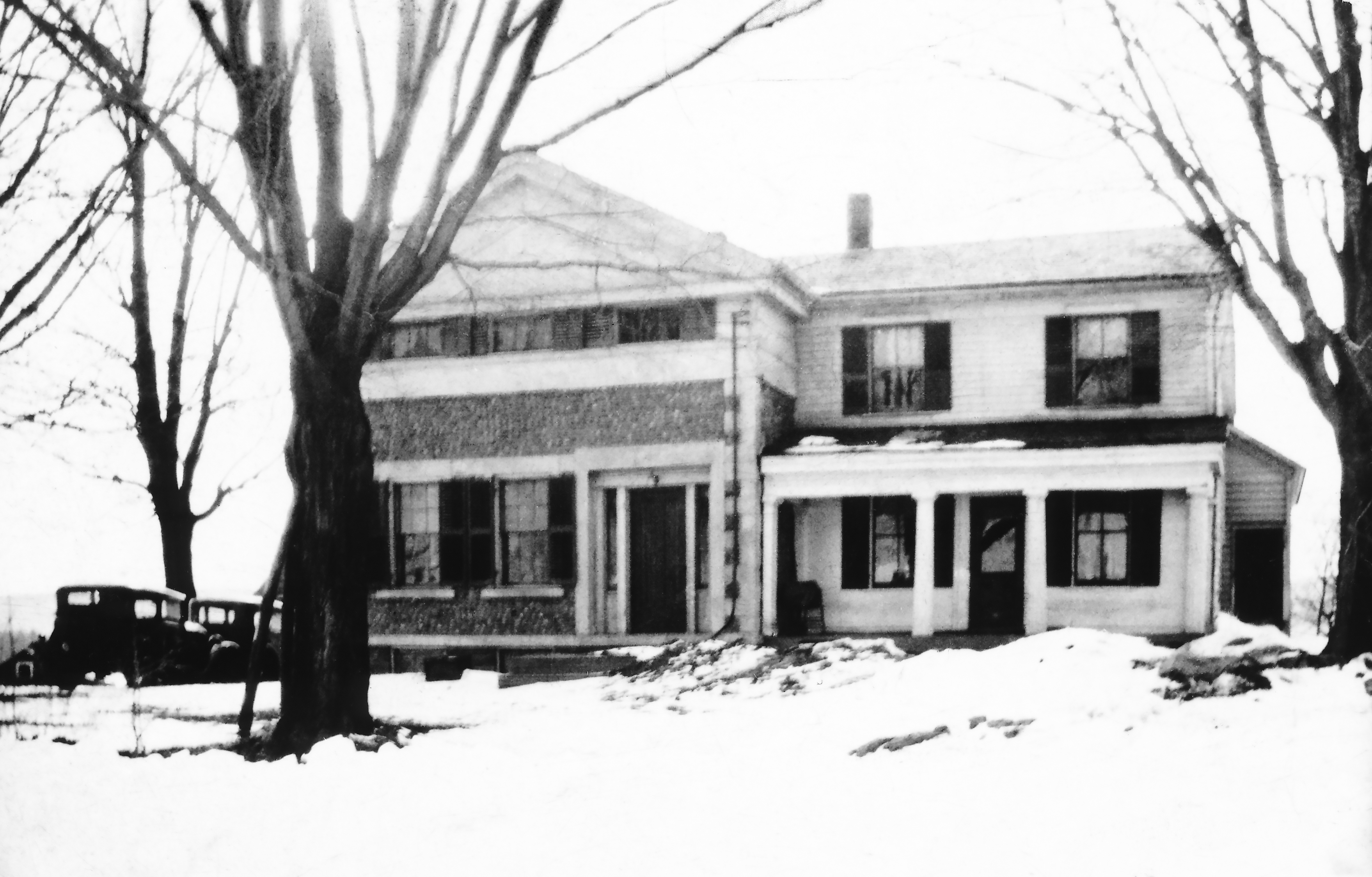
Sidney Smith house, (also known as the Dietz house), Lake Road, west side, Tully. Built 1846, burned July 29, 1933. Limestone was used for the lintels and quoins. They were quarried at Onondaga Valley and hauled to the site. Smith's name and the date, 1846, were carved on the date stone.
This house was similar to the Justice Newell House still standing on Route 11a in Cardiff. It had continuous bands of limestone that formed the lintels over the windows and door. Smith and his wife, Dolly, lived there there for many years. The property passed through several owners before it was purchased by E.G. Dietz in 1927. On the afternoon of Saturday, July 29, 1933, hay in the large barn behind the house caught fire from spontaneous combustion.
The barn was quickly engulfed in flames and was gone within 15 minutes. The wind spread flames to an adjacent building and the roof and back wing of the cobblestone house. The heat was so intense and the fire spread so rapidly that all the buildings were lost. Some antique furniture in the house was saved, but much of it was destroyed. Richard Palmer blog.
"Fire Destroys an Admired Land Mark"
Barns and Residence of E. G. Dietz Burn to the Ground Saturday
Fire started in hay in the large barn on the farm of E. G. Dietz, bordering on Green Lake, shortly after 3:00 p. m., Saturday and two hours later, this building, a smaller barn and the residence were a mass of smoking ruins.
The flames had a good start before discovered and spread so rapidly through the hay that on arrival of the Tully Hose Company within five minutes of sounding the alarm, the barn and an adjoining building were burning fiercely, the blaze blown by a stiff southwest wind directly toward the house speedily started fires in several places on the roof and an extension on the west side of the house. Water in the tanks of the pumper was soon exhausted and further supplies brought by truck was totally inadequate, the apparatus was moved to the lake, about 1200 feet distant and a stream turned on the burning house. The heat was so intense, fanned by the breeze, nothing could be done toward saving the building and within a few minutes nothing was left but the walls.
Early arrivals at the scene devoted their attention to removal of household goods, many taken out blazing, and by fast work succeeded in rescuing most of the contents of the first floor. Little was rescued from the second floor, however, on account of the smoke and flames which drove the workers away from the scene.
Flames from the house were carried into the large maple trees in front causing them to blaze up throwing sparks into a field across the road where men were kept busy beating out spreading fires in bunches of hay.
Tully fire department members declared never in their experience had they faced such a fierce and rapidly spreading fire. Fifteen minutes after the discovery of fire in the barn that building had collapsed.
All buildings are a total loss as well as part of the contents of the house and a quantity of machinery, etc., in the barns. Loss is estimated at approximately $12,000. The property was insured. The house was furnished with a collection of antique furniture, not all of which was saved, and numerous pieces considerably damaged, besides which quantities of clothing, jewelry and other articles were destroyed.
At the time of the fire Mrs. Dietz's mother was a guest of Mr. and Mrs. Dietz. Mr. Dietz was absent when fire broke out and the other occupants of the house were unaware of it until alarmed.
The house, a two story structure with a one story addition was of stone with cobble stone outer wall, the walls 18 inches in thickness and constructed of limestone hauled by teams from Onondaga Valley when the house was built in 1846 by Sidney Smith whose name was carved in a stone slab and had stood for nearly a century, admired by passersby as it stood in the setting of old maple trees. Before the railroad was built, this road was used as the direct route from Syracuse south and the route taken by stage coaches.
The property was occupied by Mr. Hennessy, father of M. Hennessy, for several years, later purchased by Merritt Hollenbeck in 1890 and occupied by himself and family for 37 years when in 1927 it was purchased by Mr. Dietz who came here from New York. Tully Newspaper, July 29,1933. Provided by Lena Hoag, then Historian, Tully, N. Y., courtesy Cobblestone Museum.
 Tul-3 Smith-Dietz 1.jpg ¹ |
¹ Image courtesy Onondaga Historical Association.
